Our Services
Sound Masking & Speech Privacy
Confidential conversations should stay that way. We design and commission sound masking systems that reduce speech intelligibility across open offices, boardrooms, healthcare spaces, and reception areas — without making the space feel noisy.
What it is
What Is Sound Masking?
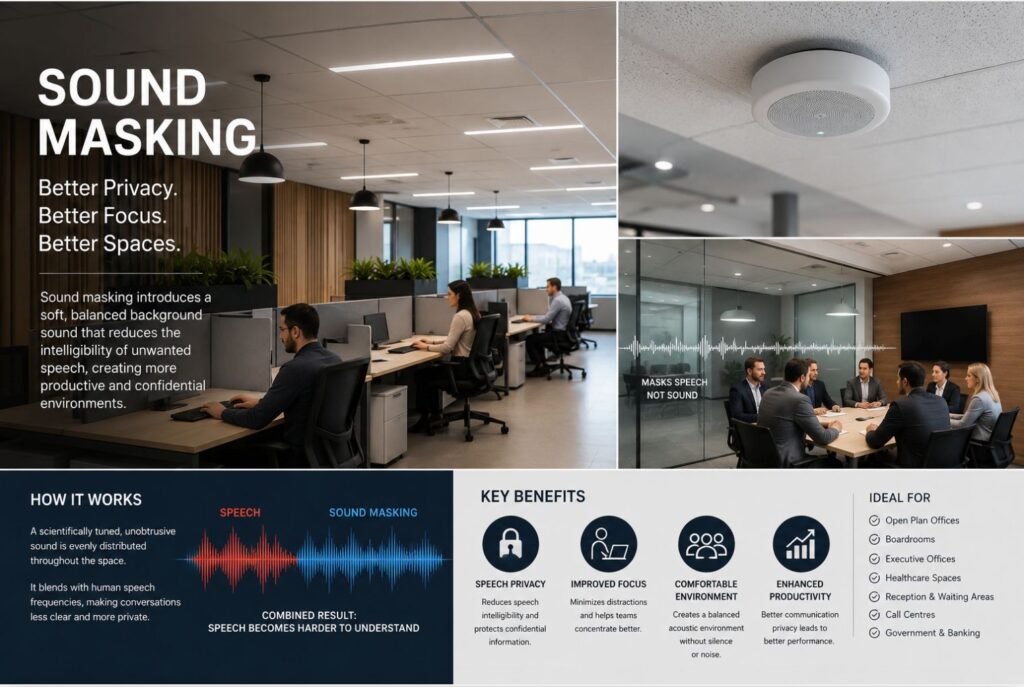
Sound masking is the use of a soft, specially engineered background sound — introduced through a dedicated speaker system installed in the ceiling — to reduce how clearly people can understand speech from a distance. The sound is carefully tuned to the frequency range of human speech, making nearby conversations blend into the background rather than cutting through it.
The aim is not to make a space noisy. Done correctly, occupants are barely aware the system is running. The effect is simply that conversations no longer carry as clearly across the room — improving privacy, reducing distraction, and making the space feel acoustically comfortable.
Sound masking makes speech harder to overhear – helping improve privacy, concentration, and acoustic comfort in modern buildings.
Sound Masking Is Not Soundproofing
This is the most common point of confusion. Soundproofing and sound masking are different solutions to different problems – and they are not interchangeable.
|
Sound Masking |
Soundproofing |
Acoustic Treatment |
|
|---|---|---|---|
|
What it does |
Reduces speech intelligibility |
Blocks sound transmission between spaces |
Reduces reverberation within a space |
|
Sound still travels? |
Yes – but harder to understand |
No – transmission reduced |
Yes – but decays faster |
|
Structural works needed? |
No |
Yes – walls, floors, ceilings |
Minimal |
|
Best for |
Open plan, reception, clinical privacy |
Between rooms, studio isolation |
Boardrooms, auditoriums, RT60 control |
|
Can be combined? |
Yes – often specified together |
Yes |
Yes |
The Principle Behind Sound Masking
Human speech is most intelligible between 500Hz and 4kHz. Sound masking introduces a continuous, low-level background sound precisely shaped to that frequency range — raising the acoustic floor of the space. When the background sound level is close to the level of a distant conversation, the brain can no longer decode the speech clearly. The conversation becomes audible but unintelligible.
This principle is measured using the Speech Transmission Index (STI) – a scale from 0 (completely unintelligible) to 1.0 (perfectly clear). Sound masking systems are designed to bring STI values in non-private zones to below 0.50, where speech from neighbouring workstations becomes too indistinct to follow.
Where Sound Masking Is Used
Sound masking is appropriate in any space where speech privacy, confidentiality, or concentration is a requirement – and where architectural or acoustic treatment alone cannot fully resolve the problem.
- Open-plan offices
- Boardrooms and meeting rooms
- Executive offices
- Clinics and consultation rooms
- Reception and waiting areas
- Call centres
- Government service counters
- Legal and financial services offices
Deliverables
Start Your Project
Tell us about your space and we’ll come back within 24 hours.
Download
Our company profile and service overview.
Start Your Acoustic Project
Tell us about your space and we’ll respond within 24 hours with an assessment plan.